
In the crowded halls of Baselworld 1999, most visitors’ attention was drawn to the vast, brightly lit stands of established Swiss luxury watch brands. Hidden away in a more modest corner, under the banner of the Académie Horlogère des Créateurs Indépendants (AHCI), a relatively unknown French watchmaker was showing a small series of tourbillon watches whose movements were not made from conventional brass or German silver, but from solid 18‑carat gold.
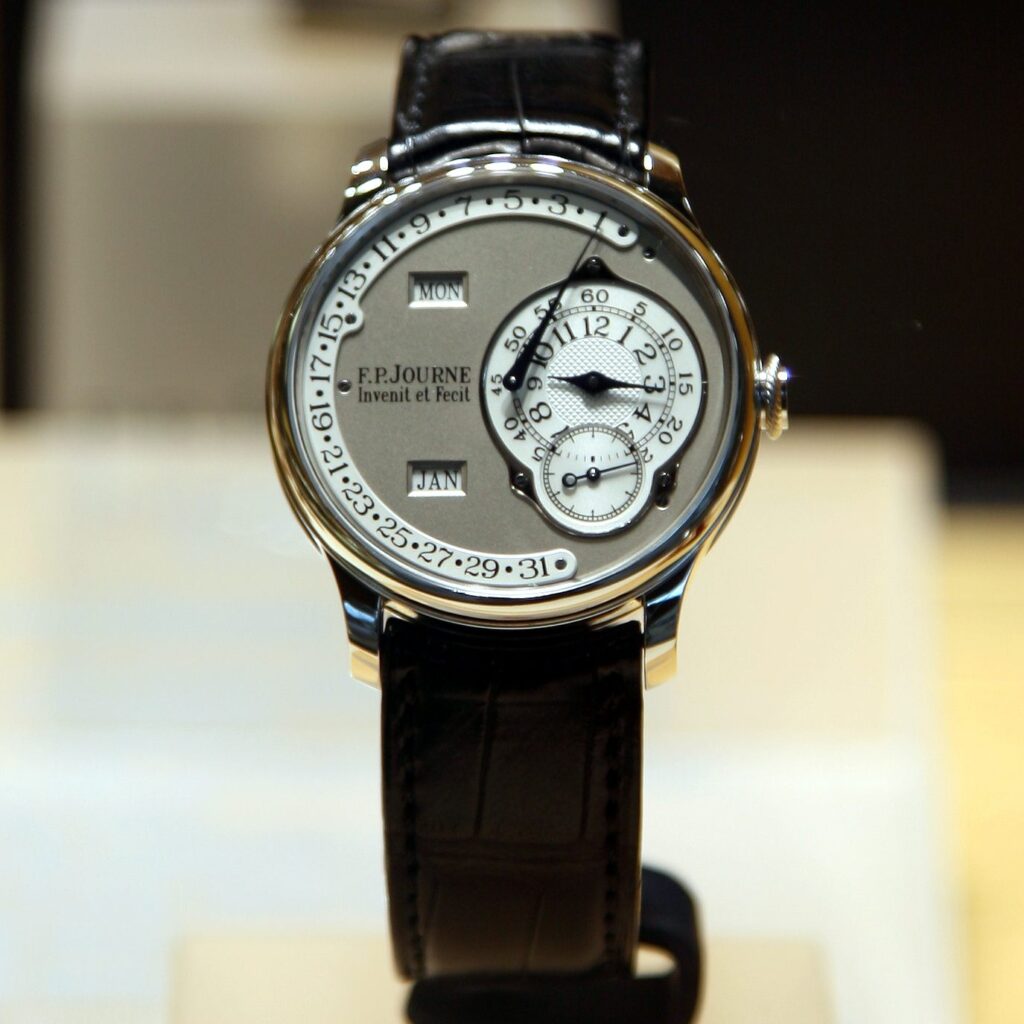
On the dial, below the name “F.P. Journe,” three Latin words appeared in small, engraved script: Invenit et Fecit—“[He] invented it and made it.”
For most passers-by, this was just another phrase. For collectors and watchmakers who knew what they were looking at, it was a statement of intent. It meant that the man behind the brand, François‑Paul Journe, had not only designed the complications in front of them but had also overseen the fabrication and finishing of the components. In an era when even prestigious Swiss luxury watch brands bought many critical parts from suppliers, this was a quietly radical position.
That moment in 1999 did not come out of nowhere. It was the visible result of more than two decades of preparation: restoration work, study of antique timekeepers, private commissions, movement development, and an increasingly clear vision of what independent watchmaking could be at the highest level.
Table of Contents
From Marseille to Paris: Learning from the Past to Invent the Future
François‑Paul Journe was born in Marseille in 1957. By his own account and that of his family, he was not a model student. Formal academics did not hold his attention for long, and he was eventually redirected to a technical college, where working with his hands suited him far better than sitting behind a desk.
That path led him to the Ecole d’Horlogerie de Paris, the Paris watchmaking school, from which he graduated in 1976. At that time, the mechanical watch industry was entering the early stages of the Quartz Crisis. Japanese manufacturers were proving that cheap, accurate quartz watches could outperform traditional mechanical movements in almost every practical respect. Many young watchmakers decided to pivot to servicing, electronics, or other trades entirely.
F.P. Journe chose a different route. After graduating, he joined the workshop of his uncle Michel in the Saint‑Germain‑des‑Prés district of Paris. This was not an industrial production line; it was a restoration atelier serving collectors of important antique clocks and pocket watches. On his bench, nineteenth‑century tourbillons, marine chronometers, and complex astronomical clocks came apart and were rebuilt. Repairing these pieces forced him to understand why master watchmakers like Abraham‑Louis Breguet, John Harrison, and Ferdinand Berthoud had made certain design choices—and where their work still had room for improvement.
During this period, Journe also encountered the work and ideas of George Daniels, the English independent watchmaker who developed the co‑axial escapement, and of P.G. Brun, a Parisian specialist in high complications. These influences reinforced a conviction that would define his career: a mechanical watch at the highest level is not simply a product; it is an argument, in metal, about how time ought to be measured.
First Major Works: Pocket Watches and Planetariums
In 1978, at the age of 22, F.P. Journe took on a commission through P.G. Brun with Asprey of London: designing a complex planetarium mechanism. Constructing an astronomical indication for a prestigious English jeweler was a significant responsibility for a young watchmaker. It required him to juggle theoretical astronomy, precision mechanics, and practical manufacturability.
Around the same time, he started work, largely for himself, on an ambitious project: a tourbillon pocket watch that would validate his abilities as a complete watchmaker. The movement would be hand‑made, the case crafted in precious metal, and the overall design rooted in the best traditions of chronometer watchmaking.
That watch was finished in January 1983. It featured a tourbillon with twin barrels and a detent escapement, with the movement made from gold. For someone in his mid‑twenties, with no factory behind him, it was a rare achievement. More importantly, it confirmed that his years spent restoring complicated antique watches had translated into the ability to design and build such mechanisms from scratch.
The Workshop Years: Bespoke Watchmaking and a Growing Vision
In 1985, F.P. Journe opened his own workshop. For roughly a decade, he produced bespoke watches and clocks for a small circle of knowledgeable clients. These were not serially produced luxury mechanical watches; many were one‑off projects that took years to complete.
Among these were an automatic chronometer pocket watch with fusée‑and‑chain transmission, five‑second remontoire, retrograde perpetual calendar, and equation of time, completed in 1986; and a planetary pocket watch in 1987. In tackling this kind of work, he was effectively running his own private research lab into high‑end haute horlogerie.
At the same time, he began to recognize the limits of this purely bespoke model. Each major commission consumed thousands of hours and produced a single piece. To create an independent luxury watch brand and reach more collectors, he would eventually need a movement platform that could be made in small series without compromising his standards.
That realization pushed him toward Switzerland. In 1989, he set up a movement manufacturing operation there, laying the groundwork for what would become his own independent manufacture. In 1991, he created his first wristwatch prototype for himself: a tourbillon wristwatch incorporating a remontoire d’égalité, or constant‑force device, rarely seen in modern watches at that time.
By 1996, he had formalized his movement work into a company called TIM SA, dedicated to designing and producing exclusive calibres. The essential pieces were now in place: decades of historical study, demonstrated ability to build extreme complications, and the industrial base to produce high‑grade movements in small series.
1999: Launching F.P. Journe and the Tourbillon Souverain
Without outside investors or a large corporate parent, financing a new independent watch brand is extraordinarily difficult. Journe turned again to watchmaking history for a solution: the “souscription” system that Abraham‑Louis Breguet had used two centuries earlier. Clients would pay a deposit upfront for a promised watch, giving the watchmaker the capital needed to start production.
Journe applied this model in 1999 with his first serial wristwatch: the Tourbillon Souverain. He proposed a run of 20 pieces to a small group of collectors, each watch to be individually numbered both on the dial and the movement. These were not affordable entry‑level mechanical watches; they were serious tourbillon watches aimed at connoisseurs.
The reception was immediate. All 20 “subscription” pieces were reserved, and it became clear that, if anything, he had underpriced them for the level of innovation and finishing they offered. Shortly afterwards, at Baselworld 1999, he showed the watch at the AHCI stand. In a fair dominated by larger Swiss watchmaking groups, this small, gold‑movement tourbillon stood out.
The Tourbillon Souverain was not remarkable simply for using a tourbillon. Its central technical and philosophical statement was the incorporation of a remontoire d’égalité—a constant‑force mechanism that ensured the escapement received a uniform amount of energy regardless of the state of wind of the mainspring. Historically used in marine chronometers and precision clocks, this device had been largely abandoned in wristwatches due to its complexity. Journe brought it back, both as a tribute to past masters and as a practical means of improving timekeeping.
Soon after, the three words “Invenit et Fecit” appeared on his dials. For Journe, the motto formalized a commitment: the movements would be his own inventions, designed, produced, and finished under his control; the watches would not be modified third‑party calibres in outsourced cases.
Invenit et Fecit: Philosophy Backed by Manufacturing
The Latin motto would have been hollow if it were not supported by real vertical integration. So, in parallel with building his first collections, Journe moved to bring key aspects of fine watchmakingunder his own umbrella.
In 2000, he helped found Les Cadraniers de Genève in collaboration with another independent, Max Büsser (who would later create MB&F). This dial manufacturer, later wholly owned by F.P. Journe, allowed him to design and control dial production to an exceptional level, from guilloché patterns to unusual finishes. Around the same time, he integrated Les Boîtiers de Genève, a case‑making specialist, ensuring his brand controlled case fabrication as well.
By 2004, a defining decision had been implemented: movement plates and bridges, which had initially been made in brass, were now systematically produced in 18‑carat rose gold. This choice was not cosmetic; it signaled a different attitude toward the internal value of the watch. In a F.P. Journe, the movement was not a hidden engine; it was the core of the object, worthy of the same precious material normally reserved for cases.
Over time, the manufacture would come to produce roughly 95% of the components that go into its watches, with only leather straps, sapphire crystals, rubies, and balance springs sourced externally. For a relatively small independent manufacture this level of control is exceptional.
Beyond the Tourbillon: Resonance and the Octa Calibre
If the Tourbillon Souverain established Journe’s seriousness, the next two major pillars of his work—Chronomètre à Résonance and the Octa collection—proved he was not going to be a one‑complication brand.
In 2000, he launched the Chronomètre à Résonance, the first wristwatch to apply the physical principle of resonance between two balance wheels. In this movement, two independent gear trains and escapements, each with its own balance, are positioned extremely close to one another. When both balances are regulated to nearly identical frequencies, they begin to synchronize through minute interactions in their oscillations. The result is self‑correcting timekeeping; minor variations in one balance are averaged out by the other.
Implementing this in a wristwatch required unusual precision. The two balances have to be adjusted to within a few seconds per day of each other, far tighter than typical production standards. The original Chronomètre à Résonance used two mainsprings. A later evolution, marking the 20th anniversary of the model, took a more elegant approach: a single barrel drives both trains via a differential, with each side then fed through its own remontoire d’égalité for constant force. The concept remained the same, but the solution became mechanically purer.
A year later, in 2001, Journe introduced the Octa—his first fully automatic base movement, known as Calibre 1300. Where the Tourbillon Souverain and Résonance catered primarily to collectors of complicated, manually wound watches, the Octa was designed to be a robust, adaptable platform for daily‑wear automatic watches.
The Calibre 1300 used a unidirectional rotor with an eccentric pivot, keeping the movement thin while allowing for large complications on the dial side. It provided an impressive 120‑hour (five‑day) power reserve while still delivering chronometer‑grade performance throughout. A large 10.1mm balance wheel and a free‑sprung construction (without a conventional regulator) underpinned stability.
On this foundation, Journe built a family of practical yet sophisticated luxury mechanical watches:
- Time and date models with power‑reserve indicators.
- The Octa Calendrier, an annual calendar with large date.
- The Octa Chronographe, a flyback automatic chronograph with big date, limited to just over 300 pieces.
- The Octa Lune, adding a moonphase display, which would win the Men’s Watch Prize at the Grand Prix d’Horlogerie de Genève (GPHG) in 2003.
- Later, variants with dual time zones and other useful complications.
Within a few years, the Octa established itself as the practical backbone of the collection, while the Tourbillon Souverain and Chronomètre à Résonance remained its more rarefied technical showpieces.
Recognition from the Industry: Multiple GPHG Wins
Between 2002 and 2010, F.P. Journe’s work received a level of formal recognition from the watch industry that few independent brands have achieved.
The Grand Prix d’Horlogerie de Genève (GPHG), sometimes described as the Oscars of watchmaking, honored Journe and his watches repeatedly:
- 2002: Special Jury Prize for the Octa Calendrier.
- 2003: Men’s Watch Prize for the Octa Lune.
- 2004: Aiguille d’Or (Grand Prize) for the Tourbillon Souverain à Seconde Morte, an evolution with deadbeat seconds powered by the remontoire.
- 2005: Men’s Watch Prize for the Chronomètre Souverain.
- 2006: Aiguille d’Or for the Sonnerie Souverain, a grande and petite sonnerie striking watch.
- 2008: Aiguille d’Or for the Centigraphe Souverain, a chronograph capable of indicating hundredths of a second.
- 2010: Complicated Watch Prize for the Chronomètre à Résonance.
Winning the Aiguille d’Or three times placed Journe in a category of his own among independent watchmakers. These prizes did not merely recognize finishing or aesthetics; they rewarded original horological thinking, executed to a very high level.
Extreme Complications: Sonnerie, Centigraphe, Astronomic
The Sonnerie Souverain, recognized in 2006, demonstrated Journe’s command of one of the most demanding traditional complications: the grande sonnerie. This mechanism requires the watch to strike the hours and quarters automatically, on demand, without disrupting timekeeping or damaging the movement. Journe’s implementation, protected by multiple patents, balanced acoustic performance, reliability, and safety systems in a movement designed for regular use.
The Centigraphe Souverain, launched in 2008, answered a different technical question: how far could the resolution of an analogue chronograph watch be pushed? Most chronographs indicate elapsed time to a fifth or eighth of a second. Journe developed a mechanism that allowed the central chronograph hand to make one revolution per second, with the scale divided into 100 increments, while keeping the timekeeping train mechanically isolated. The result was a wristwatch capable of measuring down to hundredths of a second, backed by a patented architecture and a third Aiguille d’Or.
Later, with the Astronomic Souveraine, Journe turned to astronomical complications: a complex perpetual calendar watch with equation of time, moonphase, sunrise and sunset indications, and sidereal time, among others. This was not intended as a volume model. It served as a demonstration of what his independent manufacture could achieve when given a brief to integrate multiple high‑complication functions in a coherent way.
Building a Direct Relationship: Boutiques and Anniversaire Editions
While many high‑end watch brands rely on large retailer networks, F.P. Journe pursued a strategy of brand‑owned boutiques relatively early. In 2003, he opened his first boutique in Tokyo, in the Aoyama district, in a building designed by the architect Tadao Ando. The space was conceived not just as a point of sale but as a place where collectors could engage with the brand—complete with a bar‑style counter for discussing movements and complications, and carefully designed display systems.
Tokyo was followed by boutiques in Hong Kong, Geneva, Paris, New York, Miami, Los Angeles, London, Beirut, Dubai, and Bangkok. By the mid‑2020s, the network comprised around a dozen locations.
These boutiques became the stage for a series of limited edition watches sometimes collectively referred to as Anniversaire pieces, marking milestones such as the 10th or 20th anniversary of specific locations. Small runs of Tourbillon Souverain, Chronomètre à Résonance, Octa Perpétuelle, Centigraphe Souverain, and other models were produced in boutique‑specific configurations, often in editions of 5, 12, 20, 80, or 99 pieces.
This approach reinforced several things at once: collectors had an incentive to visit and build relationships with boutiques; the brand maintained control over distribution and pricing; and F.P. Journe strengthened its identity as a boutique watchmaker rather than a mass luxury label.
How the Manufacture Works: Scale, Quality, and Integration
Behind the scenes, the F.P. Journe manufacture operates on principles more like a high‑end atelier than an industrial facility, despite producing on the order of 700–1,000 mechanical watches plus roughly 500 Élégante quartz pieces per year.
Each watch is assembled from start to finish by a single watchmaker. This is more than a romantic idea. It means each craftsman or craftswoman can understand the complete interaction of all parts, diagnose issues efficiently, and take personal responsibility for final performance. It also enables the company to offer multi‑year warranties with confidence.
Because most components—including movements, dials, and cases—are made in‑house, the brand maintains full control over tolerances, finishing quality, and aesthetic consistency. CNC machinery handles initial cutting, but traditional techniques—perlage, côtes de Genève, anglage (bevelling), black polishing—are applied extensively by hand, especially on movements, where the use of 18‑carat gold as a base metal places higher demands on skill.
By choice, the company has not expanded production dramatically, even as demand for collector watch brands like F.P. Journe has risen. This deliberate scarcity helps explain why many of its watches retain a high percentage of their original value. Auction results for early models, particularly the subscription Tourbillon Souverain pieces and certain boutique editions, regularly reach into the seven‑figure Swiss franc range.
Strategic Partnership with Chanel: Independence and Continuity
In 2018, F.P. Journe announced that Chanel had acquired a 20% minority stake in Montres Journe SA. For observers of independent watchmaking, this raised an immediate question: would the brand lose its autonomy?
The structure of the deal aimed to pre‑empt that concern. Journe retained majority control and full authority over design and production decisions. Chanel, which had previously taken minority positions in other independent watchmakers such as Romain Gauthier, explicitly framed the investment as a way to support and preserve specialized horological know‑how, not to run the company.
From Journe’s perspective, the move addressed a long‑term strategic issue: succession. By 2018, he had been working at the bench and drawing board for more than four decades. Ensuring that the manufacture would have the financial and organizational resources to continue operating after his eventual retirement mattered as much to him as maintaining independence in the present.
The partnership with Chanel thus functions less as a traditional acquisition and more as a form of institutional backing: it provides capital and potential access to a wider network without imposing a mainstream luxury group’s growth targets or design directives. Within the ecosystem of luxury watch brands, this is still rare.
Where F.P. Journe Stands in 2026
Looking across the nearly three decades since the brand’s 1999 debut, several points stand out about F.P. Journe’s position in contemporary haute horlogerie:
- It remains a genuinely independent watchmaker, with creative direction still closely tied to its founder’s philosophy.
- It operates a vertically integrated independent manufacture in Geneva and Meyrin that produces almost all components in‑house.
- It has introduced and refined some of the most technically ambitious modern complications: tourbillon with remontoire d’égalité, resonance dual‑balance systems, hundredths‑of‑a‑second chronographs, chiming watches, and astronomical displays.
- It has won the Aiguille d’Or (GPHG’s grand prize) three times—more than any other independent—and multiple category prizes.
- Its production volume remains modest by industry standards, with around 1,200–1,500 watches per year, supporting exclusivity and high long‑term value retention on the secondary market.
- Its direct‑to‑consumer boutique model gives it closer relationships with collectors than many larger brands enjoy.
For serious collectors of high‑end mechanical watches, an F.P. Journe piece is often seen less as a fashion object and more as a piece of contemporary horological history: a physical record of how one watchmaker, starting from restoration work in Paris, used deep knowledge of the past to propose new answers to the perennial problem of how best to measure time
Why the Story Resonates
What makes the F.P. Journe story compelling is not a romantic origin myth, but consistency between values, decisions, and outcomes.
From the beginning, Journe’s work has been guided by a few simple principles:
- A movement should be conceived and executed with a clear idea of what it contributes to chronometric precision or expressive watchmaking.
- Technical solutions from earlier centuries—such as remontoire, resonance, or detent escapements—should be understood deeply enough to be improved, not merely imitated.
- Independence in design and production is worth the cost in complexity and capital.
- Scarcity should result from high standards and realistic capacity, not marketing gimmicks.
- Relationships with collectors are long‑term, built on transparency and performance, not hype.
Seen against a global luxury market often driven by branding, volume, and short product cycles, this approach stands out. It explains why, when discussions among knowledgeable enthusiasts turn to the most important independent watchmakers of the modern era, F.P. Journe is always on the shortlist.
The brand’s future will, over time, be less directly tied to François‑Paul Journe the individual. Yet the systems he has built—the manufacture, the boutiques, the training of watchmakers, the product philosophy—are designed to preserve the standards that made the name significant in the first place.
For readers and collectors who care about the substance behind a luxury mechanical watch, that continuity is ultimately what makes the F.P. Journe story worth following to the very end.
Read stories about independent Japenese watchmakers like Otsuka Lotec, Naoya Hida & Co. Hajime Asaoka (Kurono Tokyo) and more.