
How a British-French Watchmaker Ended Up Creating Ultra-Luxury Handmade Watches in Rural Japan
The story of Alan Birchall doesn’t begin with luxury or ambition. It begins with a child watching his father work—the sound of machines, the precision of hands, the quiet satisfaction of creating something that lasts. At age 36, after a 16-year journey spanning four continents, Birchall has become one of the world’s most extraordinary independent watchmakers, creating timepieces that are 95% handmade on vintage machines in a small ceramics town in central Japan.
This is not a story about brand dominance or market disruption. This is the story of how one man chose the hardest path in watchmaking—true handmade fabrication—and why collectors are now waiting 12-30 months and paying ¥13,000,000 (approximately $87,000-$95,000 USD) to own his work.
| Category | Details |
|---|---|
| Full Name | Alan Birchall |
| Age | 36 years old (as of 2026) |
| Nationality | Half-French, Half-British (Australian citizen, Japan resident) |
| Total Watchmaking Experience | 16 years |
| Current Location | Tajimi, Gifu Prefecture, Japan |
| Marital Status | Married (to ceramics artist) |
| Family Watchmaking Heritage | Father: Watchmaker; Grandfather: Watchmaker; 3+ generations |
| Watchmaking Education | French watchmaking school (5 years, age 15-20) |
| Professional Experience | Switzerland (4 years) → Australia (6 years) → Japan (6 years) |
| Workshop Status | Solo operation, personally creates all watches |
| Instagram Handle | @a.birchall.watchmaker |
| Instagram Followers | 4.2K+ (as of January 2026) |
| Official Website | a-birchall.com |
| Contact Method |
The Foundation: Growing Up in a Watchmaking Family
Alan Birchall’s story begins not with a choice, but with inheritance. Born to a French mother and British father, Birchall grew up in France surrounded by the language of watchmaking. His father was a watchmaker. His grandfather before him was a watchmaker. Generations of precise hands, careful movements, and the peculiar patience required to assemble mechanisms smaller than fingernails.
“My father and grandfather are watchmakers,” Birchall explained in a MONOCHROME Watches interview . “So it was part of my daily life when growing up.”
But growing up around watchmaking isn’t the same as choosing it—until you’re told you must. In the French education system, at age 15, young students must commit to a career path that determines their secondary education trajectory. It’s a deliberate, uncompromising moment. No fence-sitting allowed. No “I’ll figure it out later.”
At 15, Birchall faced this moment. Most teenagers would resist. Birchall recognized something in himself that was impossible to ignore.
“I had to choose without really choosing to go to a watchmaking school in France, as I felt I was more of a manual person,” he recalled .
This casual observation—”I felt I was more of a manual person”—reveals something essential. Birchall wasn’t drawn to the intellectual architecture of watchmaking. He was drawn to the making part. The machines. The metals taking shape. The tangible creation of something you could hold.
He enrolled in watchmaking school in France at 15 and studied for five years—1,825 days of learning the craft that would define his life. And here’s what matters: he didn’t hate it. He didn’t endure it. He quite enjoyed it. Mechanics came naturally. The theory was intuitive. By the time he graduated, he was competent, skilled, and already knew he didn’t want the predictable path.
The Swiss Apprenticeship That Taught Him What He Didn’t Want
After graduating from French watchmaking school, Alan Birchall was 20 years old, qualified, and positioned perfectly for a conventional career. A major Swiss brand service center offered him employment. It was prestigious. It was stable. It was the path thousands of watchmakers take.
He accepted it.
For four years—from age 20 to 24—Birchall worked for one of Switzerland’s largest brands, servicing their in-house movements. This was complicated work. Perpetual calendars. Module complications. Movements that required deep understanding of how hundreds of individual components collaborated in perfect synchronization.
But something was wrong.
“I quickly got bored with this daily repetitive servicing work, and after reaching their highest complication, I knew I couldn’t stay there much longer,” Birchall revealed .
This is crucial. Birchall could have stayed. He had access to the highest level of watchmaking knowledge. The brand would have promoted him further. Instead, he recognized something that elite craftspeople understand: mastery of repetition is not the same as mastery of creation.
Every day was a variation on yesterday. Service center work, by design, involves perfecting standardized procedures. Perfect those procedures, and your value increases—but your growth stops. Birchall had reached the ceiling of what that environment could teach him.
“My options were to work for another Swiss brand with even higher complications, but still in a service centre, or move overseas again to open my eyes to the outside,” he said .
At 24, Alan Birchall made a choice that would reshape his entire trajectory. He left Switzerland. He left Europe. He applied for a position in Sydney, Australia—a city he’d never visited, speaking English as a non-native speaker, leaving behind everything familiar.
“As soon as I landed, I knew that was where I wanted to be,” Birchall remembers .
The Australian Awakening: Learning From Thousands of Watches
Sydney changed everything. Unlike the focused environment of a Swiss service center, Birchall’s new workshop exposed him to diversity. Vintage Rolex watches. Modern Omega movements. High-end Chopard complications. Patek Philippe variations across decades.
“I was servicing watches, but not only for one brand this time and was able to service a very large range of watches. Working on recent and vintage Rolex and Omega watches, as well as high-end Chopard and Patek watches, the complications were much more interesting for me,” Birchall explained .
This six-year period (age 24-30) wasn’t just work. It was an extended education in what works and what doesn’t. Birchall serviced what he calls “almost unbreakable vintage movements” alongside “terrible new mass-produced movements.” He observed good design alongside bad design. His mind was building a database of horological wisdom that no classroom could teach.
Simultaneously, Birchall was designing something on his own time—a table clock with traditional design that deliberately showcased its mechanical parts. It wasn’t a watch. It was something simpler and more profound: proof that he could create, not just repair.
The desire to make something, to create rather than service, was becoming undeniable.
But Australia, while transformative, was never meant to be permanent. At 30 years old, Birchall made another leap. He decided to move to Japan “for a short period.”
He’s still there six years later.
The Tajimi Discovery: Where Ceramics Met Watchmaking
Alan Birchall’s arrival in Japan coincided with a significant personal development: he met his wife, a ceramics artist working in Tajimi, a small town in Gifu Prefecture. Tajimi isn’t Tokyo. It isn’t known for watches. It’s known for something else entirely: ceramics.
For over 1,300 years, Tajimi has been the center of Japanese ceramic production . During the 16th century, Korean potters established kilns at the foot of Mount Takatori, creating what became known as Mino ware—celebrated for the distinctive Oribe glaze (copper green) and Shino (soft white) styles . In 1930, a local ceramicist named Arakawa Toyozō rediscovered ancient Mino kiln sites and revived traditional processes, eventually becoming one of Japan’s first “Living National Treasures” in 1955 .
Today, Tajimi is Japan’s ceramic capital—around half the nation’s ceramics and tiles come from this region . It’s not a place known for minimalism or restraint. It’s a place where tradition coexists with constant experimentation, where young artists revitalize ancient spaces with contemporary vision, and where craft isn’t a museum piece—it’s a living practice .
When Birchall arrived, he found something he didn’t expect: an environment where handmade creation was culturally valued and economically viable.
He found machines.
“I went to Japan for a short period. But it’s been six years now, and Japan is my new home with all the tools to make handmade watches,” Alan Birchall explained .
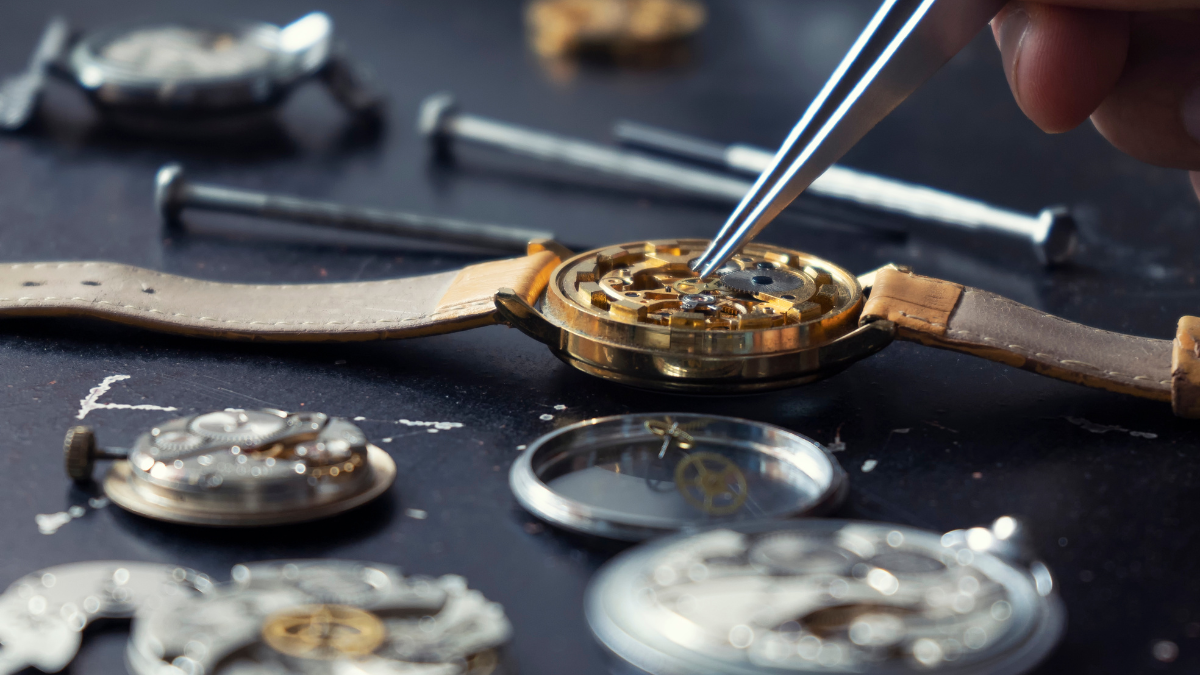
Japan, particularly rural Japan, has an abundance of vintage watchmaking and manufacturing equipment. Second-hand markets overflow with machines from closed factories. Birchall sourced 1970s-era equipment—hand-operated milling machines, lathes, and specialized tools—all manually controlled, all precise, all requiring human skill to operate effectively.
He and his ceramics artist wife now share a home divided between two crafts: her ceramic studio with its large kiln and clay dust, his watchmaking workshop with its vintage machines and metal components. It’s a practical arrangement and a philosophical statement: two artisans creating meaningful objects by hand, informed by a philosophy Birchall’s grandparents (who were dairy farmers) understood—patience.
“His grandparents were dairy farmers, and those early years gave him an intuitive understanding of agriculture,” noted isochrono’s profile . Agricultural people understand something modern culture often forgets: certain things cannot be rushed. You plant in spring, tend in summer, harvest in fall. Nature has its timeline. Birchall’s watchmaking operates on a similar principle.
The Pièce d’Essai No.00: 2.5 Years to Prove an Obsession
In 2022, Alan Birchall began sketching his first independent creation. This wasn’t a commercial project. There were no investors, no pre-orders, no business plan. This was a personal challenge: to make a watch entirely by hand, using manual machines, showcasing the art of handmade fabrication.
The result would be the Pièce d’Essai No.00—French for “test piece.”
The development timeline alone reveals Birchall’s philosophy. From first sketch to finished watch: 2.5 years. That’s 900 days of work, not counting the hours spent teaching himself techniques most modern watchmakers simply buy from specialized manufacturers.
“The biggest challenge was time; it took me 2.5 years from the first sketch to the final watch,” Birchall said . “Prototyping on a manually operated machine is time-consuming, but it is highly rewarding in the end.”
The Technical Specifications
The Pièce d’Essai emerged as a compact, elegant piece designed for Birchall’s own wrist:
Movement: A 30mm diameter caliber containing 81 individual components . Birchall fabricated 80% of those components himself on hand-operated machines—a milling machine with a 0.25mm endmill, a drill with 0.105mm precision, all manual, all requiring profound concentration. The remaining 20% consisted of components that require specialized machinery (jewels, hairspring, mainspring, crystal) .
Case: A 35.60mm stainless steel three-piece construction, designed to showcase the movement. Polished lugs. Minimal dial. The design philosophy directly reflected Birchall’s observation: tools shape the watch. Hand-operated machines are inherently time-consuming, so design should showcase the parts made with such effort .
Design Statement: A front-facing balance wheel—the beating heart of any mechanical watch—positioned where it could be observed and appreciated. This isn’t functional necessity. This is artistic choice. Birchall wanted the visual center of his watch to be its most mechanical element.
The Pallet Fork: Hours for a Millimeter
The most challenging component? The pallet fork—a minuscule piece that engages with the escapement, translating the balance wheel’s oscillations into regulated power delivery .
Manufacturing this tiny component required:
- Milling with a 0.25mm endmill (smaller than a sewing needle)
- Drilling with a 0.105mm drill
- Hours of finishing by hand
“Hours and hours of work went into that tiny component, but it was a joy when completed,” Birchall recalled .
This is the difference between acceptable watchmaking and obsessive watchmaking. Any competent watchmaker could outsource the pallet fork. Birchall chose to make it himself, to understand exactly how each curve and angle affected performance, to personally verify that this tiny component met his specifications.
The Philosophy: Handmade Versus Hand-Finished
One distinction defines Alan Birchall: he doesn’t make hand-finished watches. He makes handmade watches.
The difference is profound.
Hand-finished: A CNC machine creates a component quickly, to exacting specifications. A skilled craftsperson then decorates or refines it by hand—polishing surfaces, engraving details, applying aesthetic touches. This is how most “artisanal” watches are made. The base construction is industrial. The finishing is manual.
Handmade: A human operator manually controls a machine while actively shaping a metal component. The machine is a tool amplifying human skill, not replacing it. Errors are possible. Precision requires concentration. Each part is literally shaped by human hands operating mechanical equipment.
“Many watchmakers will buy finished wheels from specialist suppliers, and they are good quality, and ready to install,” Birchall explained . “But I wanted to cut my own wheels, sharpen my own drills, create every component from raw materials using hand-operated machines.”
This philosophy positioned Birchall in a rare category: contemporary watchmakers who genuinely handmake most of their watches. Brands like Berneron and Ressence make hand-finished watches with outsourced movements. Birchall is different. He fabricates 95% of components himself.
This isn’t marketing. This is how he works.
The Instagram Testament: Transparency as Brand Building
Unlike most independent watchmakers who cultivate mystique through secrecy, Birchall publishes his process.
@a.birchall.watchmaker documents everything: behind-the-scenes workshop footage, machine operation, part finishing, assembly procedures, testing protocols. At 4.2K followers, Birchall’s Instagram audience is small but intensely engaged—watch enthusiasts, artisanal craft appreciators, and collectors who understand that process is as valuable as product.
Recent posts show:
- Testing new jewels for future watches
- Machine setup and hand-operation technique
- Movement assembly and regulation
- The clock that taught him design principles
“What does a Master Watchmaker do to unwind in rural Japan?” one January 2026 post asked, documenting his life beyond watchmaking . This personal content—showing him as a full human, not just a watchmaking robot—builds connection with followers who understand that the best craftspeople integrate their work into a coherent life philosophy.
The transparency serves a purpose: it proves the work is real. Skeptics might dismiss a ¥13 million watch as hype. But video documentation of someone milling a 0.25mm component by hand is difficult to fake.
The Production Model: Custom Orders, One by One
Birchall’s current business model is deliberately non-scalable:
Current Status: The Pièce d’Essai No.00 is his personal prototype, worn regularly to test refinements . It is not for sale.
Next Phase: Individual custom orders, “one by one, all unique” . No two watches will be identical. Customers select case size, finishing options, and design modifications. Some modifications might require additional development time. Waiting period: 12-30 months.
Pricing: ¥13,000,000 (~$87,000-$95,000 USD at current exchange rates). Price expected to increase as reputation grows and waiting lists extend .
This model is antithetical to modern business scaling. Birchall explicitly rejects volume production. He’ll never manufacture 100 watches per year. He’ll never license his design to a larger manufacturer. He’ll never accept outside investment to “grow the brand.”
Instead, he’s chosen the artisan’s path: make fewer watches, make them better, charge prices that reflect the genuine handwork involved, and create scarcity through quality rather than marketing.
Media Recognition: The Emerging Artist
Alan Birchall’s reputation is newly established but rapidly accelerating. Major watch publications have begun serious coverage:
MONOCHROME Watches published an extensive portrait interview in September 2025, featuring Birchall’s complete personal and professional history . This wasn’t a press release. This was a comprehensive feature treating him as an important contemporary watchmaker.
isochrono published an in-depth workshop visit documentary in November 2025, photographing his workspace, machines, family environment, and creative context . The feature explored how his ceramics artist wife’s practice influences his philosophical approach, and how the Tajimi community—steeped in 1,300 years of ceramic tradition—informs his artisanal methodology.
Hodinkee covered an earlier Birchall collaboration (appears to be “Birchall & Taylor Reference 1” from 2018, a $9,500 CAD grand feu enamel dial watch), providing established credibility for his earlier work .
These publications aren’t mainstream media. They’re niche, authoritative sources read by serious collectors and watch enthusiasts. Appearing in them signals to the cognoscenti: this watchmaker matters.
The Tajimi Context: Why Rural Japan, Not Geneva or London?
Birchall could have established his workshop anywhere. Why Tajimi—a small ceramics town 30 minutes north of Nagoya, in rural Gifu Prefecture?
Part of the answer is personal (his wife). Part is practical (vintage watchmaking machines were available and affordable). Part is philosophical.
Tajimi represents something Geneva and London don’t: a living, thriving community of artisans creating beautiful objects without historical prestige driving demand. Ceramicists in Tajimi make plates, bowls, and sculptures not because they’re famous, but because they value the work. The market exists because the community values craft.
“Tajimi invites you to experience where tradition and creativity beautifully merge in daily life,” wrote the Ceramics Now guide to the region . This observation applies equally to Birchall’s watchmaking practice. He’s not creating in a vacuum of nostalgia. He’s creating in a community where handwork is normalized, where patient artisanal creation is valued, and where the economic model supports small-scale production.
This distinction matters. Birchall isn’t a romantic resurrecting dead traditions. He’s a contemporary craftsperson working in an environment where his philosophy is culturally aligned.
The Historical Roots: Three Generations of Watchmaking
Birchall’s watchmaking tradition extends beyond his lifetime. His father was a watchmaker. His grandfather was a watchmaker. This isn’t three isolated individuals who happened to choose the same profession. This is a family practice—knowledge passed through apprenticeship, understanding refined through mentorship, and skill deepened through generational experience.
Yet Birchall deliberately chose a different path from his family’s watchmaking tradition. He moved away from Europe. He refused to work for his father. He sought new environments and new influences.
This matters because Birchall’s innovation doesn’t come from rejecting tradition. It comes from understanding tradition deeply enough to evolve it.
His grandfather’s craftsmanship informed his understanding. His father’s career showed him what he didn’t want. His Swiss apprenticeship taught him industrial precision. His Australian service work educated him on design principles. His Japanese relocation allowed him to synthesize all these influences into something original.
The result: a watchmaker who combines French aesthetic sensibility, British minimalist design influence, Swiss precision methodology, Australian broad technical knowledge, and Japanese philosophical integration of craft into daily life.
The Future: What Comes After Pièce d’Essai?
Birchall’s long-term vision is deliberately modest and profound:
“I really hope I will be fortunate enough to make watches the way I like for people for as long as I can. And one day, I hope to look back on my previous work and be fully satisfied with the process,” he stated .
Notice what’s absent: ambition for market dominance, plans for brand expansion, vision of manufacturing volume. Birchall’s goal is simpler and harder: continuous improvement of his own work.
He’s already identified refinements for upcoming pieces. “My finishing level, for example, has already progressed a lot for the next one, and I’m already happy to see those slight changes,” he noted . This suggests future watches will be even more meticulously finished than the prototype.
Current projects brewing include “plenty of other ideas slowly brewing” —suggesting potential complications or design variations beyond the time-only philosophy of the Pièce d’Essai.
The Collector Perspective: Why Buy Birchall?
For ¥13 million—approximately $87,000-$95,000 USD—a collector can acquire:
- Genuine Handmade Fabrication: 95% of the watch created by hand on manual machines, not CNC assembly
- Founder Personal Involvement: Alan personally creates every component and oversees quality control
- Bespoke Customization: Complete design flexibility, tailored to individual taste
- Emerging Artist Narrative: Early adoption of a contemporary watchmaker whose recognition is rising
- Scarcity Economics: <10 pieces per year guarantees genuine rarity
- Process Transparency: Documented methodology via Instagram builds confidence in the work
- Investment Potential: Comparable to established independents (Berneron, Ressence) with upside as his reputation grows
For collectors prioritizing authentic handmade craftsmanship over established brand prestige, Birchall represents exceptional value relative to other artisanal watchmakers—with documented appreciation potential as his recognition accelerates.
The Contact and Availability
Alan Birchall accepts inquiries through two channels:
Instagram: @a.birchall.watchmaker (4.2K+ followers, direct messaging enabled)
Website: a-birchall.com (official information and contact details)
Location: Tajimi, Gifu Prefecture, Japan
Current waiting period for new custom orders: 12-30 months from deposit.
Conclusion: The Persistence of Handmade in a Modern World
Alan Birchall’s story is not unique in isolation. There are other independent watchmakers. There are other artisans rejecting CNC automation. There are other craftspeople choosing scarcity over scale.
What makes Birchall’s story compelling is that he represents something increasingly rare: a contemporary craftsperson building an international reputation through process transparency and genuine handwork, not through brand legacy or marketing prowess.
At 36 years old, Birchall is simultaneously at the beginning of his watchmaking career (only six years independent) and at the mastery level of his craft (16 years total experience, working on his own terms). He’s creating watches that cost more than most people’s cars, using machines from the 1970s, in a small ceramics town in rural Japan, sharing his process on Instagram to 4.2K followers.
The watches aren’t cheaper than competitors. They’re not more accessible. They’re not designed for mass appeal. They’re designed for collectors who understand that the handwork itself is the primary product, and the timepiece is merely the vessel containing that work.
This philosophy has sustained handmade watchmaking for centuries. Alan Birchall is simply the latest evolution of it—a British-French craftsperson, trained across four continents, now creating in rural Japan, proving that true artisanal watchmaking isn’t a nostalgia play.
It’s a living, evolving practice. And for those fortunate enough to wear one of his watches, it’s a 2.5-year proof of human dedication to a craft that refuses to be mechanized, industrialized, or compromised.
Stories from Independent Watchmaking
Alan Birchall’s dedication to true handmade watchmaking echoes throughout the independent scene. Naoya Hida & Co. achieves similar intentionality through neo-classical revisionism and tiny production scales, while Otsuka Lotec channels industrial design philosophy into award-winning complications. Each proves that small-scale watchmaking—whether it’s Birchall’s 95% handmade process, Naoya Hida’s seven-person atelier, or Otsuka Lotec’s self-taught approach—can redefine luxury by prioritizing process over production.