
The Saxon Rebellion: The 36-Year Odyssey of Nomos Glashütte
The story of Nomos Glashütte doesn’t begin in a sleek boardroom or a heritage-rich archive; it begins in the eerie, industrial silence of a town that had forgotten how to be itself. In January 1990, just eight weeks after the Berlin Wall was breached, Roland Schwertner drove his car into the Ore Mountains of Saxony. To any other visitor, the village of Glashütte was a ghost of its former self. Once the undisputed cradle of German high horology, it had spent forty-five years as a cog in the Soviet-bloc machine, producing utilitarian, state-mandated “GUB” watches for the masses. The grand villas of the watchmaking barons were crumbling, and the precision that once rivaled Switzerland was buried under layers of socialist industrialization.
Schwertner was an outsider—a photographer and IT expert from Düsseldorf—which is perhaps why he saw what the locals couldn’t. He didn’t see ruins; he saw a vacuum. He realized that while the factories were dilapidated, the “human capital”—the watchmakers who had spent decades maintaining the town’s mechanical traditions—was still there, waiting for a reason to care again. He founded Nomos Glashütte in a rented space at Am Erbenhang 21, but he immediately ran into the town’s long, litigious memory.
The Ghost of 1906: The Name and the Law
The name “Nomos” wasn’t just a Greek word for “law” or “rule”; it was a ghost. Between 1906 and 1910, a different company called Nomos-Uhr-Gesellschaft had operated in Glashütte. They were the “bad actors” of their era, importing Swiss movements, casing them up in Saxony, and selling them as “Glashütte” watches to exploit the town’s prestige. They were eventually sued into bankruptcy by the legendary A. Lange & Söhne, who argued that the “Glashütte” name should only be used if the majority of the watch’s value was created in the town.
By reviving the name in 1990, Schwertner wasn’t just starting a brand; he was picking up a fallen banner and daring the town to challenge him. He knew that to succeed, he had to be more “Glashütte” than the natives. This historical footnote is crucial because it shaped Nomos’s obsession with vertical integration. They didn’t just want to make watches; they wanted to prove they weren’t the imposters of 1906. This meant that the “Nomos Law” would eventually require them to build their own hearts—a goal that would take them twenty-four years to achieve.
The Genesis of a New Aesthetic: 1992
While Schwertner handled the logistics, the brand’s visual soul was placed in the hands of Susanne Günther. In 1992, she introduced four watches that would become the “Four Pillars” of the brand. These weren’t designed in a vacuum. Günther had gone into the local archives and uncovered sketches from the 1930s—drawings from the Deutscher Werkbund era that had been suppressed or ignored during the GDR years.
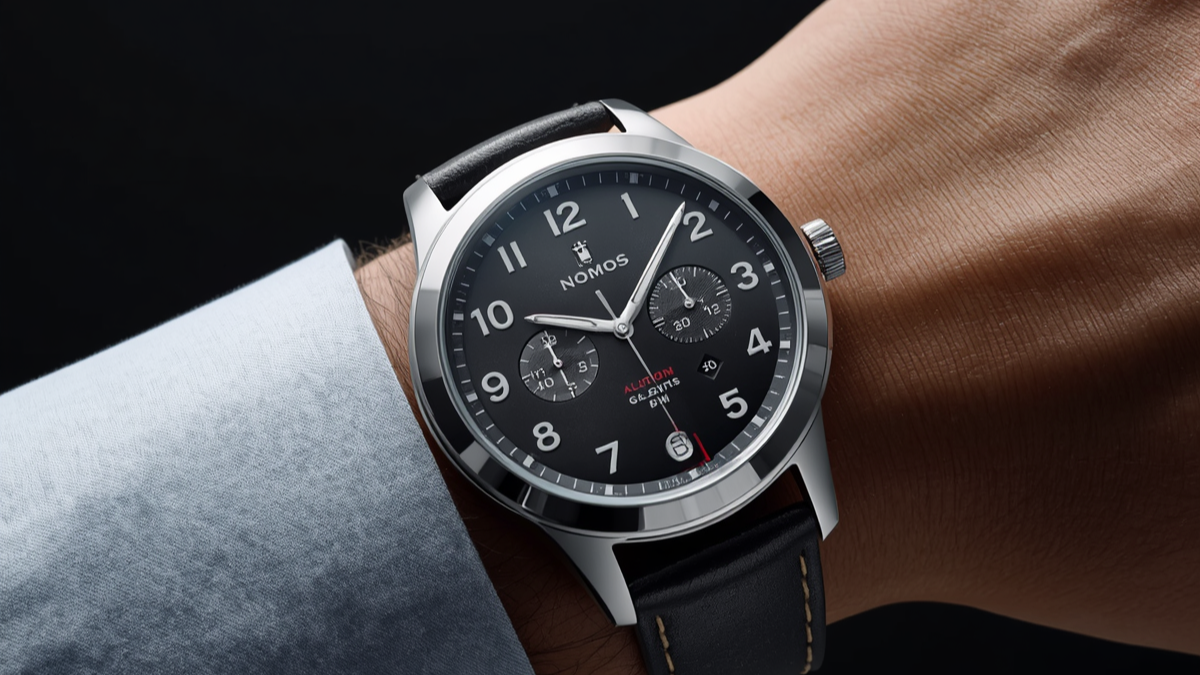
The Tangente, which remains the brand’s most famous face, was a manifesto in steel. It rejected every Swiss trope of the early 90s. There were no gold cases, no diamonds, and no complex “guilloché” (engine-turned) patterns. Instead, there was a stark, white-silvered dial with a font that felt more like architecture than timekeeping. The alternating Arabic numerals (2, 4, 8, 10, 12) and the small-seconds subdial at 6 o’clock created a sense of balance that felt both antique and futuristic.
Alongside the Tangente came the Orion, a watch so minimalist it lacked numerals entirely, relying on gold or silver batons to mark the passing hours. The Ludwig paid homage to tradition with Roman numerals, while the Tetra offered a square case—a rare shape in an industry obsessed with circles. These four models were the “hand-wound” foundation of the brand, but they contained a secret: their hearts were still Swiss.
The Struggle for the Heart: From Peseux to Alpha
For the first thirteen years, Nomos used the Swiss Peseux 7001 manual movement. It was a reliable, ultra-thin caliber, but it was a thorn in Schwertner’s side. To call a watch a “Glashütte” timepiece, local laws required that 50% of the movement’s value be created in the town. Nomos met this by heavily modifying the Swiss parts—replacing the bridges with a traditional Glashütte three-quarter plate and adding heat-blued screws.
But as the brand grew, the Swiss “monopoly” (the Swatch Group) began tightening its grip on the supply of movements. Schwertner realized that if he didn’t innovate, he would always be a tenant in someone else’s house. In 2005, Nomos introduced the Alpha (α) caliber. It was a manual-wind movement that, while still sharing the architecture of the Peseux 7001, was now being manufactured almost entirely in-house in Glashütte.
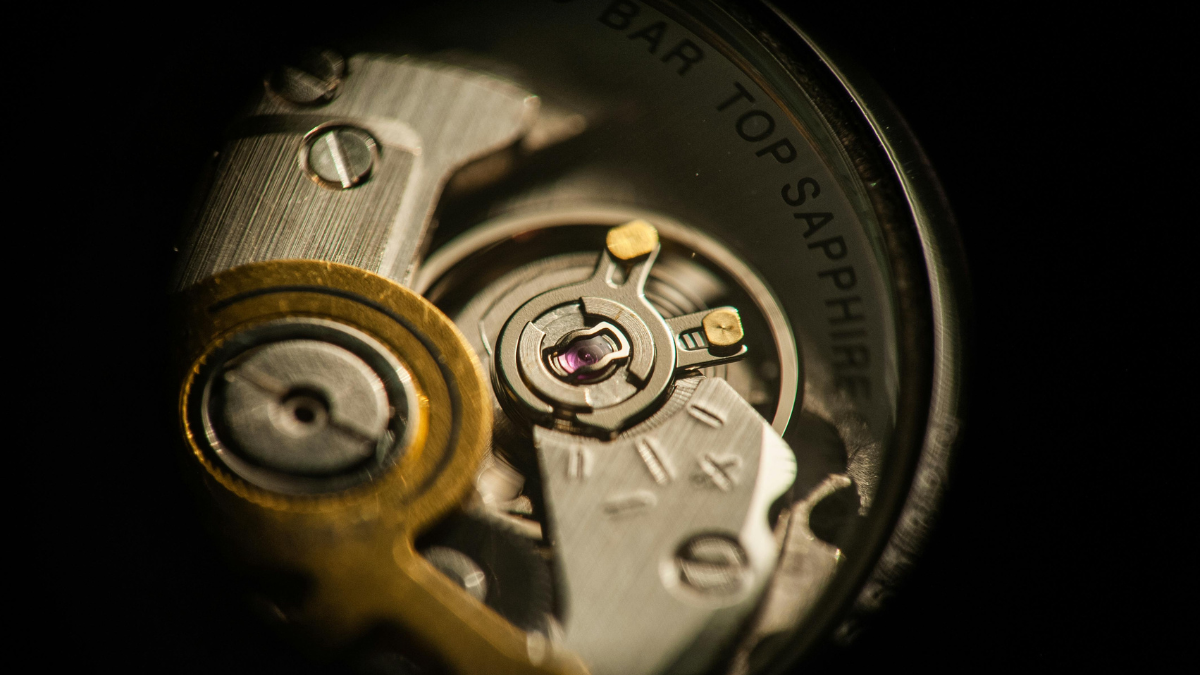
This was the moment Nomos transitioned from a “design firm” to a “manufacture.” They began using German Silver (Neusilber) for their plates—an alloy of copper, nickel, and zinc that develops a warm, golden patina over time. Unlike the rhodium-plated brass used by the Swiss, German Silver is temperamental; if a watchmaker touches it with a bare finger, the oils from their skin will leave a permanent mark. This choice spoke to the brand’s commitment to high-stakes, manual craftsmanship.
The Seven-Year Gamble: The Swing System
The real “war” for independence began in 2007. While Nomos could now make plates and gears, they still couldn’t make the escapement—the tiny group of parts (the balance wheel, hairspring, and pallet fork) that actually regulate time. Almost every brand in the world—even high-end Swiss houses—buys these parts from Nivarox, a subsidiary of the Swatch Group.
Schwertner knew that true independence meant making the hairspring. This was a task so difficult that many industry experts called it a “suicide mission” for a small brand. The hairspring is a coil of wire thinner than a human hair, made of a specific alloy that must expand and contract with absolute mathematical precision across decades of temperature changes.
For seven years, Nomos worked in secret with the Technical University of Dresden and the Fraunhofer Institute. They invested €12 million—a staggering sum for an independent company—to master the metallurgy and the “swing” of the balance. In 2014, they unveiled the Nomos Swing System.
The hallmark of this system is a tiny, heat-blued hairspring. It wasn’t just a part; it was a “Moon landing” for the brand. They debuted it in the Metro Datum Gangreserve, designed by Mark Braun. The Metro was a departure from the rigid lines of the Tangente, featuring wire lugs and a dial inspired by automotive gauges. It was a celebration of technical freedom. No longer beholden to Switzerland, Nomos could finally grow as large as its vision allowed.
Engineering the Ultra-Thin: The Neomatik Revolution
With the Swing System proven, the engineering team turned toward the “automatic” problem. Automatic watches are notoriously thick because they require a rotor to wind the spring. For a brand obsessed with slim, elegant profiles, a thick watch was a failure. In 2015, they released the DUW 3001 (the “Neomatik”).
The DUW 3001 was a masterclass in spatial efficiency. At only 3.2mm thick, it was barely larger than a stack of two coins. To achieve this, the engineers had to redesign the gear train entirely, increasing the “winding efficiency” to an unheard-of 94.2%. Most mechanical watches lose a massive amount of energy to internal friction; Nomos reduced the tolerances to a point where the movement was both incredibly thin and incredibly accurate, meeting chronometer standards.
This was followed by the DUW 6101 in 2018, which added a date complication. But instead of a traditional “date wheel” that sits in the middle of the movement, Nomos created a peripheral date ring. This allowed the date window to be placed at the very edge of the dial, keeping the proportions of the watch perfectly balanced.
| Caliber | Type | Thickness | Special Feature |
| Alpha | Manual | 2.6mm | The first in-house “workhorse” |
| DUW 3001 | Automatic | 3.2mm | Ultra-thin Neomatik |
| DUW 6101 | Automatic | 3.6mm | Peripheral Date ring |
| DUW 3202 | Automatic | 4.8mm | Worldtimer with 24-hour display |
The Berlin-Glashütte Paradox
This technical rigor is balanced by a creative office that feels worlds apart from the quiet mountains of Saxony. Berlinerblau, the brand’s design studio in Berlin’s Kreuzberg district, is the creative engine. Led by Judith Borowski, this is where the fonts are drawn, the colors are chosen, and the “Nomos vibe” is curated.
This duality is what makes Nomos a “living” brand. The watches are engineered in a place where people go to bed at 9 PM, but they are designed in a place where the nightlife is just starting. This tension was never more apparent than in the 2018 release of the Autobahn. Designed by Werner Aisslinger, the watch featured a deep, curved dial and a massive lume-arc that resembled a speedometer. It was polarizing—some called it “un-Nomos”—but it proved the brand wasn’t afraid to alienate its own fans in the pursuit of something new.
The 175-Year Celebration and the Color Explosion
As Nomos entered 2024, it reached a cultural milestone: 175 years of watchmaking in Glashütte. To celebrate, they did something uncharacteristic. They took their most conservative icon, the Tangente 38 Date, and released it in 31 different colors.
Each colorway was limited to 175 pieces, and they ranged from the demure to the electric. Names like “Chili” (a fiery crimson), “Dunkelbunt” (a black dial with red and blue accents), and “Lemonbiscuit” (a creamy, pale yellow) showed a brand that had finally found its sense of humor. One model, the “Sportbunt,” was even inspired by a vintage GDR-era tracksuit worn by an employee in the manufacture.
By 2025 and 2026, this willingness to play with color has become a core part of the brand’s identity. The new Minimatik Date 39 (released in early 2025) features a gold-framed date window and a larger 39.5mm case, signaling that Nomos is finally catering to the “modern wrist” size without sacrificing its minimalist soul.
The Three Rooftops of Glashütte
Today, the production of a Nomos watch is a journey across three specialized facilities in the village:
- Schlottwitz: This is the high-tech heart. Located in a neighboring district, this facility houses the CNC machines that turn raw bars of steel and brass into the microscopic gears and plates of the movement.
- The Former Train Station: This iconic building serves as the brand’s administrative and assembly hub. Here, master watchmakers sit in silence, assembling the hundreds of parts that make up a DUW movement.
- Am Erbenhang: The original birthplace, perched on a hill overlooking the town. This is now the “Chronometrie” center, where the most complicated movements (like the DUW 1001 in the gold Lambda models) are regulated and finished by hand.
The Price of Independence: 2026 Market Context
In the 2026 landscape, the watch industry is increasingly dominated by giant conglomerates like Richemont, LVMH, and the Swatch Group. In this world, “in-house” is usually a synonym for “expensive.”
If you want an in-house automatic dress watch from a Swiss brand, you are often starting at €7,000. Nomos, by remaining independent and family-owned, has managed to keep its prices accessible. The Club Campus (manual-wind) remains the “gateway drug” for young enthusiasts at around €1,500 – €2,000, while their most complex worldtimers, like the Club Sport Neomatik Worldtimer, sit comfortably around €4,500 – €5,500.
Critiques and the “Lug Gap” Controversy
No brand is without its critics. For years, Nomos has faced the “too simple” critique from collectors who prefer the ornate complexity of Swiss watchmaking. There is also the persistent “lug gap” debate—models like the Club have long, curved lugs that leave a visible gap between the strap and the case. While some see this as a design signature, others find it aesthetically jarring.
Furthermore, the brand’s commitment to slimness often comes at the cost of “heft.” If you are used to the weight of a Rolex Submariner, a Nomos can feel dangerously light, almost like a toy. But for the Nomos loyalist—the architects, designers, and academics who make up their core base—this lightness is the point. It is a watch that is meant to be worn, not just “displayed.”
What makes Nomos Glashütte unique?
Nomos Glashütte matters because it is a “Third Way.” It is more technically rigorous than any fashion watch or microbrand, yet more culturally relevant than many of the aging Swiss houses. It is a brand that survived the fall of the Wall, the collapse of the Saxon industry, and the monopoly of the Swiss suppliers.
When you look at a Nomos in 2026, you are looking at the result of a 36-year rebellion. You are looking at a movement with a 95% in-house production rate, a proprietary escapement that the experts said was impossible to build, and a design philosophy that refuses to shout.
Roland Schwertner’s drive into the mountains in 1990 didn’t just revive a town; it proved that the “Nomos Law” was real. In a world of loud, oversized luxury, Nomos remains the master of the quiet tick. It is proof that sometimes, the most radical thing you can do is keep things simple.