
Philippe Dufour: The Quiet Master Who Redefined Independent Watchmaking
In a watch world obsessed with novelties, limited editions, and social‑media hype, there is one name that quietly sits above most of the noise: Philippe Dufour. He has no sprawling product catalog, no aggressive marketing team, and no shiny boutique network. In fact, over almost three decades of producing watches under his own name, he has made only around 230 pieces in total. Yet mention “Philippe Dufour watches” to serious collectors and you will hear a tone of reverence usually reserved for long‑dead masters.
This is the story of how a young apprentice from the Vallée de Joux became, in the eyes of many, the greatest living independent watchmaker, and how just three iconic models—the Grande & Petite Sonnerie, the Duality, and the Simplicity—turned his name into one of the most powerful brands in haute horlogerie, even without trying to be a brand at all.
A Boy from the Vallée de Joux
The story begins in 1948, in Le Sentier, a small village in Switzerland’s Vallée de Joux. This valley is often called the cradle of haute horlogerie, home to houses like Audemars Piguet and Jaeger‑LeCoultre. For local families, watchmaking is not an abstract luxury; it is part of the landscape, as familiar as forest and snow.
At 15 years old, while many teenagers are still deciding what they want to be, Philippe Dufour made a straightforward, almost practical choice: he enrolled at the Ecole d’Horlogerie de la Vallée de Joux, the local watchmaking school. He completed his training and graduated in 1967, entering the trade at a time when mechanical watchmaking was about to be rocked by the quartz crisis.
After school, he did what many ambitious young watchmakers did: he joined the big names. Jaeger‑LeCoultre was his first stop, followed by General Watch Company, Gérald Genta, and Audemars Piguet. These years were his apprenticeship in high‑end complications and industrial watchmaking. They gave him a close‑up view of the way large manufactures operate and the kind of compromises that come with scale.
Somewhere along the way, a tension formed. Dufour loved the old methods, the way 19th‑century watchmakers treated each movement as a piece of art and engineering. But the industry around him was becoming more corporate, more cost‑driven, more standardized. The more he restored old pocket watches, the more he saw what had been lost.
The Restorer Who Revived the Sonnerie
In 1978, Dufour took a step that would change his life: he left the security of big brands and set up as an independent restorer in the Vallée de Joux. His clients were museums, collectors, and sometimes the brands themselves, sending him complicated antique pieces that required the kind of skill that could not be mass‑produced.
Restoring these watches did more than pay the bills. It gave him a living library of old solutions—minute repeaters, perpetual calendars, tourbillons, and chiming watches—that he could study and internalize. In particular, he became fascinated by the most demanding of them all: the grande sonnerie and petite sonnerie, mechanisms that strike the time automatically as it passes, not just on demand.
Between 1982 and 1988, Dufour undertook an audacious project: he designed and built from scratch a new grande & petite sonnerie pocket‑watch movement, in the traditional style but using his own construction. Audemars Piguet ordered five of these movements, casing them under their own name. Each one took roughly 2,000 hours of work, close to a full year per piece.
These five pocket watches did three crucial things:
- They proved that Dufour could design and execute one of the most complex complications in watchmaking on his own.
- They gave him a financial cushion and a circle of high‑end clients.
- They planted a seed: if he could do this for others, why not do it with his own name on the dial?
Signing His Own Name: The Birth of a Brand
By the early 1990s, the mechanical watch was staging a comeback. The quartz crisis had devastated many traditional brands, but a new generation of collectors had started to appreciate the artistry and heritage of mechanical horology again. In this environment, a watchmaker like Philippe Dufour had a rare opportunity.
In 1992, he took the leap. At Baselworld 1992, he presented the first wristwatch to bear his own signature: the Philippe Dufour Grande & Petite Sonnerie.
The choice of complication was not modest. This wristwatch combined:
- Grande sonnerie – automatically chiming the hours and quarters as time passes
- Petite sonnerie – chiming only the quarters, without repeating the hours
- Minute repeater – chiming hours, quarters, and minutes on demand, at the slide of a lever
According to authoritative sources, this was the first wristwatch ever to feature a grande and petite sonnerie with minute repeater in one movement. It was an extraordinary technical statement for a one‑man workshop to make.
From a branding perspective, it was just as radical. Dufour was not reviving an old name or launching a marketing‑driven line. He was saying, quietly but clearly: “Here is my work, under my own name.” His “brand” was nothing more and nothing less than his personal reputation as a watchmaker.
In hindsight, this decision helped define the template for the modern independent watchmaker: small workshops, ultra‑high‑end pieces, direct relationships with clients, and total creative control. But in 1992, it was still a bold, almost eccentric move.
The Grande & Petite Sonnerie Wristwatch: A Private Symphony
Very few Grande & Petite Sonnerie wristwatches were ever made. Exact numbers are not publicly confirmed, but all sources agree the production is extremely small, in the single or low double digits. Each piece combined technical density with a surprisingly understated aesthetic: classic case shapes, elegant dials, and the movement hidden beneath solid casebacks or modest displays.
What made the watch remarkable was not just that it chimed. It was how it chimed, and how it was finished.
Dufour’s chiming wristwatches embody traditional Vallée de Joux sonnerie construction:
- Two separate gear trains—one for timekeeping, one for striking
- Smart switching between grande, petite, and silence modes
- Gongs and hammers tuned and adjusted entirely by hand
On the movement side, every bridge, every bevel, every steel component bore the marks of hours of hand‑finishing: sharp interior angles, mirror‑polished bevels, flawless Geneva stripes, and black‑polished steel that reflects light like liquid.
Collectors took notice, but the wider market was not yet ready to crown an independent watchmaker as a star. Over time, though, the myth grew. When a unique Grande & Petite Sonnerie with a sapphire dial eventually appeared at auction, it achieved a price in the multi‑million‑dollar range, one of the highest ever paid for a wristwatch by a living independent watchmaker.
The sonnerie had done its work. Dufour had shown he could play at the absolute top level of technical haute horlogerie. His next creation would show that he could be just as radical in subtlety.
Duality: When Two Hearts Beat as One
In 1996, Philippe Dufour introduced his second model: the Duality. If the Grande Sonnerie was about chiming complexity, the Duality was about pure chronometry—timekeeping accuracy pushed to an extreme.
The idea was inspired by historical precision pocket watches that used multiple balance wheels to improve stability. In the Duality, Dufour created the first wristwatch to feature two separate balance wheels connected by a differential.
Here is what makes the Duality special:
- It has two complete regulating organs—each with its own balance wheel, balance spring, and escapement.
- These two systems beat independently, but their output is combined by a differential, a gear system that calculates the average rate of the two.
- In theory, if one balance is slightly fast and the other slightly slow, the average will be closer to perfect time.
Visually, the Duality is a lesson in restraint. On the dial side, it looks like a traditional, beautifully proportioned time‑only watch: classic round case, small seconds, refined typography. Only when you flip it over does the secret reveal itself: two balances symmetrically arranged, dancing in mirrored harmony, with the differential nestled between them.
Originally, Dufour planned to make 25 examples of the Duality. In the end, he produced only nine. That tiny production number, combined with the technical innovation and hand finishing, made the Duality one of the most coveted independent watches ever made.
In 2017, a Duality with serial number 00 appeared at a Phillips auction in New York and sold for almost US$1,000,000, far exceeding its estimate. For a relatively understated, time‑only watch (at least from the front), the message was clear: connoisseurs recognized just how special this construction was.
Still, Dufour was not done redefining what a watch under his name could be. His most famous creation was yet to come, and it would look, at first glance, almost ordinary.
Simplicity: The Ultimate Expression of “Time‑Only”
At the turn of the millennium, Philippe Dufour did something counterintuitive. After launching a chiming wristwatch and a dual‑balance chronometer, he turned to what many would consider the most basic form of watchmaking: a three‑hand time‑only watch with small seconds.
In 2000, he introduced the Philippe Dufour Simplicity.
Seen from across the room, a Simplicity could pass for a beautifully made, traditional dress watch. It comes in 34 mm or 37 mm cases, with rounded lugs, a thin bezel, and a dial that is often a warm, slightly creamy shade of lacquer or silver. Applied markers, Breguet‑style blued hands, and a small seconds at six o’clock complete the look. It is the opposite of loud.
But collectors know that the magic of the Simplicity is on the movement side.
Dufour designed the Simplicity as a kind of manifesto for traditional hand finishing. The movement, seen through the sapphire back, is laid out in a classic Vallée de Joux style: large bridges, balanced symmetry, wide bevels. Every surface is touched by hand:
- Anglage (bevelling) with razor‑sharp internal corners, which can only be created by hand with files and patience
- Côtes de Genève that flow cleanly across bridges with flawless rhythm
- Perlage (circular graining) on the mainplate, perfectly overlapped
- Black‑polished steel on screw heads, cap jewels, and a swan‑neck regulator, reflecting light like a pool of ink
When collectors and watchmakers talk about the “best finished movement in the world,” they are often thinking of the Simplicity.
Originally, Dufour intended to make 100 Simplicity watches. Demand, however, exceeded his expectations. Over time, he increased the total production to roughly 200–205 pieces, split across the 34 mm and 37 mm cases. Including other models, FHH estimates that between 1992 and 2020 he produced about 230 watches in total, which suggests just how dominant the Simplicity is in his body of work.
For more than a decade, he built Simplicity watches at a rate of just a few per year, with waiting lists stretching for years. Collectors who received one often kept it; the watch rarely appeared on the secondary market. When it did, it steadily climbed in price.
By the mid‑2010s, auction houses began to chart this ascent. In 2016, a Simplicity sold at Phillips for over €260,000. In subsequent years, other examples continued to set records in the low to mid six‑figure range, depending on configuration and condition. For what is, on paper, “only” a time‑only watch, this was remarkable.
The 20th Anniversary Simplicity: A Farewell Crescendo
In 2020, two decades after the first Simplicity, Dufour announced something collectors had hardly dared to hope for: a 20th anniversary series of the Simplicity. This final run would consist of 20 watches, all in 37 mm cases, made in white gold, pink gold, or platinum.
Each anniversary piece followed the core design codes of the original but was numbered xx/20, marking it as part of this farewell series. The very first of them, numbered 00/20, appeared at auction in Geneva and achieved around CHF 1.3 million. Shortly after, another 00/20 Simplicity sold at Phillips for CHF 1.36 million, setting a new record for a Dufour Simplicity.
These results confirmed what the market already believed: the Philippe Dufour Simplicitywas no longer just a cult favorite among insiders; it was a globally recognized icon of independent haute horlogerie. For many, it became the reference point when judging the finishing of any high‑end mechanical watch.
Inside the Workshop: Tradition Over Technology
Part of the fascination with Philippe Dufour as a watch brand is that the “brand” is essentially one man and his bench.
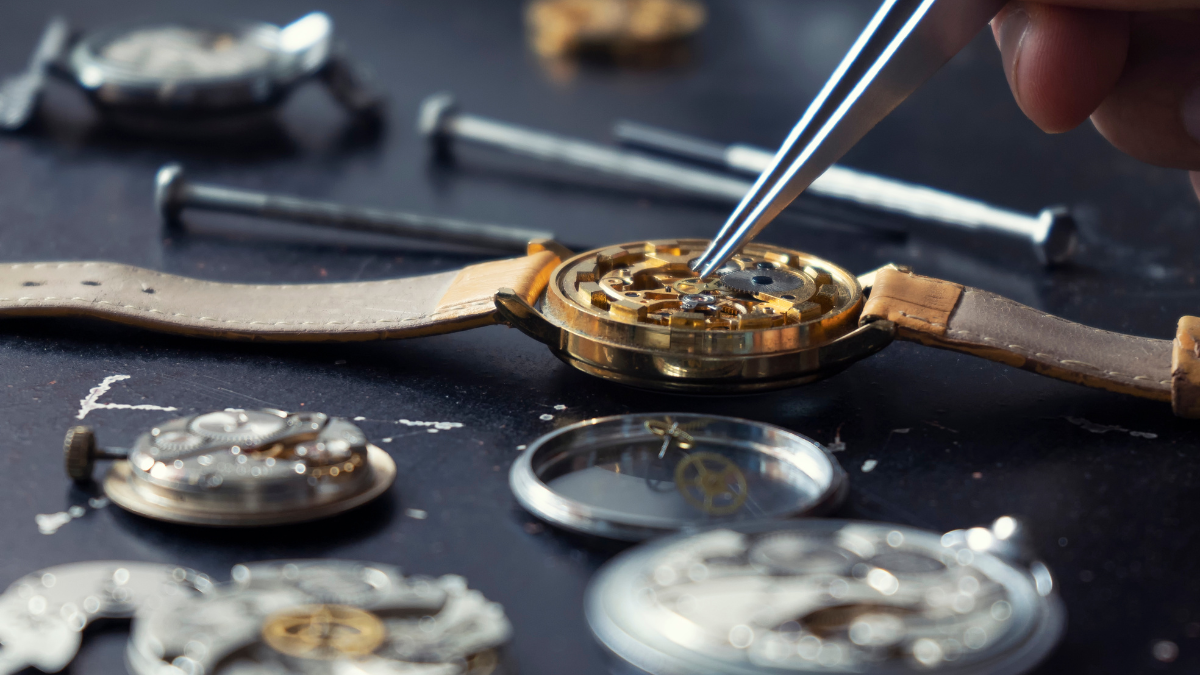
His workshop remains in the Vallée de Joux, close to where he was born. Photos and descriptions from visits show a space that feels more like a craftsman’s atelier than a modern manufacture: wooden benches, traditional tools, and movements in various stages of assembly under simple lamps.
Several key principles define his approach:
- Small Scale by Design
Dufour has never tried to scale up production significantly. Over nearly thirty years, he has averaged roughly eight watches per year, an output more akin to an artist’s studio than a luxury brand. - Traditional Tools and Methods
While most of the Swiss watch industry relies heavily on CNC machines and modern automation, Dufour deliberately keeps things low‑tech where it matters. He uses:- Hand files for bevels
- Wooden and felt wheels for polishing
- Simple jigs and fixtures instead of sophisticated robotics
- Modern tools are not banned, but they are kept in the background. The character of the watch is determined by what passes through his hands.
- Near‑Total Involvement – Over the years, Dufour has been assisted at times by one or two watchmakers, but multiple sources emphasize that he personally performs or checks the critical finishing and assembly stages. This is not a factory; it is a master and a very small team.
- No Compromise on Finishing – For Dufour, finishing is not cosmetic. It is an ethical issue—respect for the craft, for the client, for the object itself. This philosophy is what led some commentators to call him the “conscience of modern watchmaking.”
When collectors talk about “independent watchmaking,” this is the ideal they imagine: a dedicated artisan, working slowly, making as few concessions as possible to efficiency, and producing watches that feel almost alive with human labor.
More Than a Brand: A Teacher and a Conscience
Philippe Dufour’s influence extends far beyond the watches that bear his name.
Over the years, he has quietly advised and collaborated with others in the high‑end watch world:
- He is known to have advised TAG Heuer on upgrading the finishing of the experimental Monaco V4, a radical belt‑driven watch that needed its technical innovation matched by better handwork.
- He played a central role in “Le Garde Temps: Naissance d’Une Montre”, a multi‑year project led by Greubel Forsey, Dufour, and watchmaker Michel Boulanger. The idea was to build a watch almost entirely with traditional hand‑tools and methods, documenting each step to preserve endangered knowledge.
- He has been closely associated with Seiko’s Micro Artist Studio in Japan, the workshop behind the Credor Eichi and related high‑end pieces. The finishing on those Japanese watches—particularly the anglage and black polishing—shows a clear kinship with Dufour’s standards.
Through these collaborations, Dufour has served as a mentor and benchmark for watchmakers around the world. Even brands that will never match his level of handwork still aspire to his philosophy: fewer shortcuts, more respect for the invisible parts, and a belief that the inside of the movement matters as much as the dial.
Quill & Pad captured this role well when it argued that “why Philippe Dufour matters” is not just about his own watches, but about how he:
- Proved an independent watchmaker could thrive under his own name
- Raised expectations for movement finishing across the industry
- Helped transmit traditional know‑how to a new generation
Collectability and the Market’s Verdict
In pure branding terms, Philippe Dufour is an anomaly:
- No big marketing budget
- No celebrity ambassadors
- No new releases every year
Yet his watches sit at the apex of the independent watch market, and the auction results prove it.
A few key milestones illustrate how the market values “Philippe Dufour watches”:
- Simplicity
- 2016: A Simplicity sold at Phillips for over €260,000, far above typical prices for comparable time‑only pieces at the time.
- 2020–2021: Anniversary Simplicity 00/20 pieces achieved around CHF 1.3–1.36 million at auction, confirming the model as one of the most desirable independent haute horlogerie watches in the world.
- Duality
- 2017: The Duality N°00 sold at Phillips for almost US$1,000,000, with only nine examples of the model known to have been completed.
- Grande & Petite Sonnerie
- A unique example with a sapphire dial fetched around $3.7 million at Phillips, setting a record level for a wristwatch by a living independent watchmaker.
These numbers place Dufour in a very small group of living creators whose work regularly commands seven‑figure prices. For collectors of luxury Swiss watches, owning a Dufour has become a kind of ultimate statement: not about status in the mainstream luxury world, but about deep, insider appreciation of traditional watchmaking.
What Makes the “Philippe Dufour Brand” Unique?
From the outside, it might seem paradoxical to talk about “the Philippe Dufour brand,” because so much of his appeal lies in being almost anti‑brand. But if a brand is what people think and feel when they hear a name, then Philippe Dufour has one of the strongest brand identities in the entire watch industry.
Several factors make it unique:
- Radical Scarcity, But Not Manufactured Hype
The total output—about 230 watches in nearly 30 years—is tiny, but the scarcity is a by‑product of his methods, not a marketing ploy. Each watch simply takes that long when you insist on doing things this way. - Three Models, Zero Fluff
Instead of dozens of references, he has focused on three core watches:- The Grande & Petite Sonnerie wristwatch – the pinnacle of chiming complications
- The Duality – a technical tour de force of dual balances and differential
- The Simplicity – the distilled essence of classical watchmaking
- Each has a clear purpose and story.
- Finishing as Brand DNA
For many watch enthusiasts, the phrase “Philippe Dufour finishing” is almost a category of its own. The Simplicity movement is used as a teaching reference in articles and lectures about finishing techniques in high‑end watchmaking. - Independence in the Deepest Sense
Dufour is not part of a group. He is a member of the Académie Horlogère des Créateurs Indépendants (AHCI) and won the Gaïa Prize in 1998, but his brand decisions are his own. There are no shareholders pushing him to increase production or launch a sports watch. - Cultural and Historical Significance
In the history of independent horology, he stands as a bridge between the old Vallée de Joux masters and today’s avant‑garde independents. Without people like Dufour showing that an individual could survive selling watches under his own name, it is hard to imagine the same ecosystem existing for names like Voutilainen, Halter, or Journe.
For someone exploring independent watch brands today, Philippe Dufour is both the origin story and the gold standard.
An Enduring Legacy in Haute Horlogerie
Today, Philippe Dufour is in his late seventies. New watches from his bench are rare, and the order book for the Simplicity is closed. The handful of pieces that might still appear will likely be special projects or final commitments rather than new series.
Yet his influence feels more current than ever. Young watchmakers still study photos of his movements to understand what true hand finishing looks like. Established brands quietly benchmark their high‑end calibres against the Simplicity, knowing most customers may never see the comparison but caring about it anyway. Collectors of independent Swiss watches often talk about their journey “before” and “after” they first handled a Dufour.
In a world where luxury watch marketing often leans on slogans and celebrity endorsements, Philippe Dufour built his fame almost entirely through word of mouth and visible craft. His story is a reminder that, at the very top of haute horlogerie, the most powerful branding tool is still the same as it was a century ago: a watch that, when you hold it under the light, needs no explanation at all.
If you ever find yourself turning over a watch and seeing “Philippe Dufour” on the movement, you are not just looking at a luxury product. You are holding a piece of living horological history—the work of a man who chose slowness over scale, perfection over production, and, in doing so, quietly reshaped what independent watchmaking could be.
Discover more Independent watchmaker – Masa’s Pastime: From Junk Shop to Haute Horlogerie and the famous korean watchmaker – Eugène Kim.